Hello all. It's been a while since I've written anything, mainly because I returned from India four weeks ago. I'm not quite sure how long I will continue to write in this blog. Will I start a new one, or let them go altogether? Who knows. And most likely, most people who were reading this are no longer doing so. Still, let's just pretend I have at least one reader...
Hindus in India have a belief and subsequent ritual that confused me for a long time. As I'm sure you know, the Ganga/Ganges is considered the holiest river in India. Of course, don't forget about the Indus, the Krishna, the Yamuna, the Saraswati (which doesn't really exist anymore), the Godavari, the Brahmaputra, the Cauvery (or Kavery), etc., not to mention the three most important rivers in Gujarat: the Sabarmati, the Narmada, and the Tapti. All of these rivers, along with the hundreds more, are holy. So holy, in fact, that prayer is essential at each one. Mandapams, temples, and shrines line the shores of each one. Often, as people drive cars or ride trains over rivers, they touch their hands to their hearts in a sign of reverence. Many bless a paise or so before throwing it out the window into the water below. Signs of respect. So, the question is: Why?
I raised this question with a few folks, and the response was always religious: Because she is one of our goddesses...um...okay. Rivers are shes, that's normal. And sure they are goddesses. But is that why they are holy? Or have the rivers been manifested as goddesses because they are holy? The religious explanation explains the result, not the cause, of the holiness. Plus, why should anyone believe it? I may believe in the goddess Narmada Devi, but why should I believe in a Brahmaputra Devi, since I've never even seen the river?
Then, I heard the perfect explanation, one that wholly changed my view of rivers forever. Rivers are, in one word, life. As a student of anthropology and archaeology, I should have thought of this. Essentially, every civilization in the world came about due to a river. Rivers are the source of flowing, fresh water for trade, irrigation, waste disposal, drinking and cleaning, and bathing. Lakes are too stagnant to sustain any growing civilization. Seas and oceans are too salty. So, rivers it is. Without rivers, where would we be? Well, I certainly wouldn't be here, writing a blog that probably no one will read. No, there wouldn't be any civilization. There wouldn't have been tribes, which led to chieftains, which led to states. None of that would exist. Sure, perhaps we would have made it work. But not to the point of getting where we are today.
Rivers are holy because without them, we wouldn't exist. It's as simple as that. So, the next time you pass by a river, show it some reverence. Touch your right hand to your heart, even for a moment. (I wouldn't recommend throwing money out of a moving car...you'll probably hit someone or some vehicle with it.) Show respect. Be reverent. And thank every river you see for giving you everything you have.
Tuesday, May 02, 2006

Thursday, March 23, 2006
Love Him or Hate, You Can't Not Talk About Him
He is currently the most important person in Gujarat. And he's also one of the most controversial is Indian history. He has been blamed for one of the worst disasters in Gujarati history. He is praised for solely improving Gujarat as a whole. Most Gujaratis love him. Most non-Gujaratis would rather he was gone. So, who is he?
Chief Minister Narendra Modi.
Okay, let's start with the bad. If you don't like what I have to say, comment. But don't yell. I've already gotten enough of that...from relatives! Alright, Godhra. 2002. A fire aboard the Sabarmati Express, killing Hindus returning from the controversial site of Ayodhya 10 years after the violence there. Muslims were blamed for firebombing the train. Riots started throughout Gujarat, resulting in thousands dead, mostly Muslim. Hindus claim that they were reacting. But no one knows who actually started the fire, and all objective investigations have shown the fire to be of natural causes. Still, the reaction was fairly natural, though the real questions are why the violence went on for so long, and why the police actually joined the Hindus in killing Muslims. Narendra Modi has been blamed for all this. Most Guju Hindus will claim that he is falsely accused, and that the police were doing what was necessary to maintain the peace. Never mind that per Modi's personal command, the vast majority (I don't remember the actual number, but I knew it at one point) of Muslim policemen were placed into desk positions where they couldn't do anything. Nevermind that the state government had actually compiled lists of Muslim and Hindu businesses, which were then handed out to Hindu leaders. Muslim shops and homes were destroyed, while Hindu ones remained fairly intact. Narendra Modi, of the BJP Party, is claimed to have masterminded the whole thing as a sort of nationalist experiment. I don't know if I believe it. Still, there's a lot of evidence against him.
And yet, at an election that occurred after all the implications and violence, he won by a landslide and landmark 80 percent. Of course, I doubt that many Muslims voted for him. Now, four years after the violence, the state has never been more peaceful, and things are really on the up and up. Infrastructure here rocks. Even state highways and village roads are pretty good. He has required that all autorikshas in Ahmedabad, Surat, and Rajkot be converted to CNG (see previous post). All state buses also must switch over to CNG. He has improved schools, supported the local economy, and worked to preserve historical landmarks. He has shown that he cares for all religious groups, not just Hindus. And he has worked to bring IT to Gandhinagar, the capital. All in all, he has done amazing work in Gujarat, and most Gujus here love him.
Good or bad. We don't know. He made some mistakes, perhaps with the intention to cause Hindus to gain power. But now, no complaints. He is the ideal CM.
Chief Minister Narendra Modi.
Okay, let's start with the bad. If you don't like what I have to say, comment. But don't yell. I've already gotten enough of that...from relatives! Alright, Godhra. 2002. A fire aboard the Sabarmati Express, killing Hindus returning from the controversial site of Ayodhya 10 years after the violence there. Muslims were blamed for firebombing the train. Riots started throughout Gujarat, resulting in thousands dead, mostly Muslim. Hindus claim that they were reacting. But no one knows who actually started the fire, and all objective investigations have shown the fire to be of natural causes. Still, the reaction was fairly natural, though the real questions are why the violence went on for so long, and why the police actually joined the Hindus in killing Muslims. Narendra Modi has been blamed for all this. Most Guju Hindus will claim that he is falsely accused, and that the police were doing what was necessary to maintain the peace. Never mind that per Modi's personal command, the vast majority (I don't remember the actual number, but I knew it at one point) of Muslim policemen were placed into desk positions where they couldn't do anything. Nevermind that the state government had actually compiled lists of Muslim and Hindu businesses, which were then handed out to Hindu leaders. Muslim shops and homes were destroyed, while Hindu ones remained fairly intact. Narendra Modi, of the BJP Party, is claimed to have masterminded the whole thing as a sort of nationalist experiment. I don't know if I believe it. Still, there's a lot of evidence against him.
And yet, at an election that occurred after all the implications and violence, he won by a landslide and landmark 80 percent. Of course, I doubt that many Muslims voted for him. Now, four years after the violence, the state has never been more peaceful, and things are really on the up and up. Infrastructure here rocks. Even state highways and village roads are pretty good. He has required that all autorikshas in Ahmedabad, Surat, and Rajkot be converted to CNG (see previous post). All state buses also must switch over to CNG. He has improved schools, supported the local economy, and worked to preserve historical landmarks. He has shown that he cares for all religious groups, not just Hindus. And he has worked to bring IT to Gandhinagar, the capital. All in all, he has done amazing work in Gujarat, and most Gujus here love him.
Good or bad. We don't know. He made some mistakes, perhaps with the intention to cause Hindus to gain power. But now, no complaints. He is the ideal CM.
More Things India Has Done Right
Here we go:
1. Chappal Toe Loops. Indians must constantly remove their shoes. Entering a temple or a house are good reasons. And on a good day, you're removing, putting on, removing, putting on, etc. So, if you have chappals (sandals, also called champals), it's important that you don't have a back to them, simply for ease. However, then this can cause problems with keeping the chappals on your feet. So, Indians were smart, and created a separation between the big toe and the rest. This either occurs through a separate look, or through a peg that sticks up. This separation helps the chappal stay on the foot.
2. Cloth Bags. Shopping bags in India tend to be cloth, and each household has a couple. This helps with the plastic consumption here. Of course, different fruits and veggies are wrapped in separate plastic bags. Still, the cloth bags are much appreciated.
3. CNG. Compressed Natural Gas is now becoming more common in autorikshas, and even in some buses. This has helped to lower air pollution in many larger cities, like Mumbai, Bangalore, Ahmedabad, and Surat. And these new systems aren't even a choice. They are required by corporation (city) or state laws. And of course many petroleum companies have jumped in to take advantage of this by starting CNG stations. Still, clean air is a plus. And I have already started to see a difference.
1. Chappal Toe Loops. Indians must constantly remove their shoes. Entering a temple or a house are good reasons. And on a good day, you're removing, putting on, removing, putting on, etc. So, if you have chappals (sandals, also called champals), it's important that you don't have a back to them, simply for ease. However, then this can cause problems with keeping the chappals on your feet. So, Indians were smart, and created a separation between the big toe and the rest. This either occurs through a separate look, or through a peg that sticks up. This separation helps the chappal stay on the foot.
2. Cloth Bags. Shopping bags in India tend to be cloth, and each household has a couple. This helps with the plastic consumption here. Of course, different fruits and veggies are wrapped in separate plastic bags. Still, the cloth bags are much appreciated.
3. CNG. Compressed Natural Gas is now becoming more common in autorikshas, and even in some buses. This has helped to lower air pollution in many larger cities, like Mumbai, Bangalore, Ahmedabad, and Surat. And these new systems aren't even a choice. They are required by corporation (city) or state laws. And of course many petroleum companies have jumped in to take advantage of this by starting CNG stations. Still, clean air is a plus. And I have already started to see a difference.
Is This the Same Religion?
Okay, time for differences between the regions, dealing with Hinduism.
1. Havelis. Okay, generally speaking, a haveli is a type of house found in Gujarat and Rajasthan. However, here, havelis typically refer to a house of religion. BUT it's not a temple. Havelis do not have the typical shape and feel of a temple, and often times you don't even know that it is a temple unless someone takes you. Sometimes, only the next difference is the only sign of it's religiosity.
2. Flags. This is specific to Saurashtra, meaning that it isn't even found in Eastern Gujarat (Kuchch I don't know). All the houses of worship, at least the Hindu ones, have flags over them. So, mandirs (Hindu temples), derasars (Jain temples), akshardams (Swaminarayana temples), and havelis all have flags proudly flying overhead. I am so appreciative of this, because I often times would not be able to find a haveli without the flags.
3. Turtles. One of the very first things I did when I arrived to Gujarat was to go to a Shiva haveli for Shivratri. And the first thing I noticed as I approached the murti (statue) for darshan (viewing) was that, at the front feet of Nandi (the bull) was a flat-ish statue of a turtle, of course with a svastika (the original one, not the Nazi one) on it. People would touch it right after Nandi, thus showing it some reverance. Now, I know enough about Shiva to know that he is not associated with a turtle. So, what was up with this? My theory is that it has to do with the second avatar (incarnation) of lord Vishnu. He was a turtle, used as the base for a pole turned by gods and demons to churn up amrit (divine nectar) from the bottom of an ocean. I think this is the only turtle really mentioned in Hindu mythology. The funny thing is, I don't think most Gujarati Hindus know why the turtle is even there. So, if any of you readers know, please let me know.
4. Jalarama Bapa. Also found only in Saurashtra, not even in most of Kuchch (this I know). Jalarama Bapa is very much like a Guju and Saurashtran Jesus. He preached religion with a social purpose, performed miracles, and now has lots of people worshipping him. I don't think either historical figures ever wanted people to treat them as gods, and yet that's what has happened. Jalarama Bapa is EVERYWHERE in Saurashtra.
5. Krishna. No, Krishna is everywhere in India. But there is something here that I don't think any other religion has ever done. It's so weird to me, I just can't seem to understand it. Krishna is important...there's no doubt about that. His entire life (yes, even as a god, he had a lifespan) has been carefully documented, and at different points in his life, he did different things. Therefore, people don't simply worship Krishna here in Gujarat, but they worship a part of his life. Balakrishna (baby Krishna) is really popular, in which worshippers treat him like any baby, actually spending an entire day doing nothing but taking care of his murti. There are rituals for waking him up, giving him breakfast, putting him down for a nap, etc. I have never seen anything like it. Another very popular one is Srinathji, who is Krishna as a child. Worship of Srinathji is very popular in Southern Rajasthan and in Saurashtra, and has curiously skipped over Kuchch. There's even a worship for an adolescent Krishna, though I don't remember what he's called at this stage. Amazing. I really have never seen anything like this.
1. Havelis. Okay, generally speaking, a haveli is a type of house found in Gujarat and Rajasthan. However, here, havelis typically refer to a house of religion. BUT it's not a temple. Havelis do not have the typical shape and feel of a temple, and often times you don't even know that it is a temple unless someone takes you. Sometimes, only the next difference is the only sign of it's religiosity.
2. Flags. This is specific to Saurashtra, meaning that it isn't even found in Eastern Gujarat (Kuchch I don't know). All the houses of worship, at least the Hindu ones, have flags over them. So, mandirs (Hindu temples), derasars (Jain temples), akshardams (Swaminarayana temples), and havelis all have flags proudly flying overhead. I am so appreciative of this, because I often times would not be able to find a haveli without the flags.
3. Turtles. One of the very first things I did when I arrived to Gujarat was to go to a Shiva haveli for Shivratri. And the first thing I noticed as I approached the murti (statue) for darshan (viewing) was that, at the front feet of Nandi (the bull) was a flat-ish statue of a turtle, of course with a svastika (the original one, not the Nazi one) on it. People would touch it right after Nandi, thus showing it some reverance. Now, I know enough about Shiva to know that he is not associated with a turtle. So, what was up with this? My theory is that it has to do with the second avatar (incarnation) of lord Vishnu. He was a turtle, used as the base for a pole turned by gods and demons to churn up amrit (divine nectar) from the bottom of an ocean. I think this is the only turtle really mentioned in Hindu mythology. The funny thing is, I don't think most Gujarati Hindus know why the turtle is even there. So, if any of you readers know, please let me know.
4. Jalarama Bapa. Also found only in Saurashtra, not even in most of Kuchch (this I know). Jalarama Bapa is very much like a Guju and Saurashtran Jesus. He preached religion with a social purpose, performed miracles, and now has lots of people worshipping him. I don't think either historical figures ever wanted people to treat them as gods, and yet that's what has happened. Jalarama Bapa is EVERYWHERE in Saurashtra.
5. Krishna. No, Krishna is everywhere in India. But there is something here that I don't think any other religion has ever done. It's so weird to me, I just can't seem to understand it. Krishna is important...there's no doubt about that. His entire life (yes, even as a god, he had a lifespan) has been carefully documented, and at different points in his life, he did different things. Therefore, people don't simply worship Krishna here in Gujarat, but they worship a part of his life. Balakrishna (baby Krishna) is really popular, in which worshippers treat him like any baby, actually spending an entire day doing nothing but taking care of his murti. There are rituals for waking him up, giving him breakfast, putting him down for a nap, etc. I have never seen anything like it. Another very popular one is Srinathji, who is Krishna as a child. Worship of Srinathji is very popular in Southern Rajasthan and in Saurashtra, and has curiously skipped over Kuchch. There's even a worship for an adolescent Krishna, though I don't remember what he's called at this stage. Amazing. I really have never seen anything like this.
The Differences Never End!
Time for more differences between Gujarat and the South...the Secular Edition.
1. Rice. Yes, one of the many foods I'm sick of by now. The reason? South Indians eat rice as a main part of their meal. It's the most important part of the thali or meal. Gujus are a bit different. We prefer to have only a little rice at the end of the meal, to help finish the remaining food. If I would have started in Gujarat, I would not have been so sick of rice...or I would have been sick of rice, and then have starved in the South. Who knows?
2. Tempos. Eh? A big ol' autoriksha that can fit a minimum of 6 people, though I've seen many many more piled in. Supposedly these exist in the South, but I never saw a single one in three months. The moment I arrived in Gujarat, I saw them everywhere, particularly in Surat and in Saurashtra. Tempos are bigger and much much noisier than the plain autos. Still, they can be useful with larger groups.
3. Jai. Who needs "Hello" and "Goodbye" when you have the word "Jai?" No, Gujus don't just use this word, but they always stick something on the end of it, adapting it to whomever the recipient of the greeting is. Once it's said, the recipient must then repeat it. For example, with Jains, you say "Jai Janendra." With anyone on my Mom's side of the family, we say "Jai Sheeyarama." With most other people, it's "Jai Sheekrishna." For Prayag Bhai, it's "Jai Gurudev." For Shanti Prasadji, it's "Jai Swaminarayana." You get the idea. We say this when we meet and when we part ways. And whoever starts first...that's the one used. For example, when Shanti Prasadji dropped me home from Latidhad, Dadaji was the first to speak. So, we all said "Jai Swaminarayana." If Shanti Prasadji had spoken first, then it would have been "Jai Janendra," simply because the recipient was Jain. This form of greeting does not exist in the South at all. I wonder if it exists anywhere else.
1. Rice. Yes, one of the many foods I'm sick of by now. The reason? South Indians eat rice as a main part of their meal. It's the most important part of the thali or meal. Gujus are a bit different. We prefer to have only a little rice at the end of the meal, to help finish the remaining food. If I would have started in Gujarat, I would not have been so sick of rice...or I would have been sick of rice, and then have starved in the South. Who knows?
2. Tempos. Eh? A big ol' autoriksha that can fit a minimum of 6 people, though I've seen many many more piled in. Supposedly these exist in the South, but I never saw a single one in three months. The moment I arrived in Gujarat, I saw them everywhere, particularly in Surat and in Saurashtra. Tempos are bigger and much much noisier than the plain autos. Still, they can be useful with larger groups.
3. Jai. Who needs "Hello" and "Goodbye" when you have the word "Jai?" No, Gujus don't just use this word, but they always stick something on the end of it, adapting it to whomever the recipient of the greeting is. Once it's said, the recipient must then repeat it. For example, with Jains, you say "Jai Janendra." With anyone on my Mom's side of the family, we say "Jai Sheeyarama." With most other people, it's "Jai Sheekrishna." For Prayag Bhai, it's "Jai Gurudev." For Shanti Prasadji, it's "Jai Swaminarayana." You get the idea. We say this when we meet and when we part ways. And whoever starts first...that's the one used. For example, when Shanti Prasadji dropped me home from Latidhad, Dadaji was the first to speak. So, we all said "Jai Swaminarayana." If Shanti Prasadji had spoken first, then it would have been "Jai Janendra," simply because the recipient was Jain. This form of greeting does not exist in the South at all. I wonder if it exists anywhere else.
Whoops 2: Proofreading...Who Needs It?
English is an important language in India...no doubt about that. One would imagine, then, that people in top positions in national and international companies would know enough written English to make sure even the smallest things like labels and signs have correctly written English. I have a simple example...the toilet in the upstairs room at my Grandfather's house. There are two labels on the top toilet seat indicating the manufacturer of the seat: Citizen. However, one of the labels says "Citizan." If this were the only label, I might think that this was the actual name, but of course, it's not. Below the correctly-written name is a warning label. The first word should be "Maintenance," but it's misspelled. "Maintenace." Was it really that difficult to check the spelling? Hell, the company even mispelled its own name! And this is just one of many examples.
Whoops 1: But Your Advertisement Said...
In America, there are laws against false advertising. Not so in India. You can lie as much as you want, and very little can be done against you. Let me give you two examples.
The first is a two-wheeler made by Bajaj, a very large company in India. The advertisement is great. A cool man is standing there near his motorcycle, holding onto some sunglasses. A group of motorcyclists shoot by, and one man grabs the sunglasses out from our hero's hand. So, he gets on his Bajaj to chase them, but of course he takes a shortcut. He's shooting through the forest...no issues so far. Suddenly, you see him at a dam, going so fast that he's defying gravity. He's actually sideways, like if you move a cup of water so quickly that the centrifugal (or is that centripetal?) force is so great the the water doesn't fall out when the cup goes sideways. Bajaj's two-wheeler is so fast, it can become like a Graviton ride at a carnival. Of course, our fast hero beats the gang and coolly rescues his sunglasses, winning the attention of a female. Moral of the story: this motorcycle will help me win chicks (or birds, as they call them in India), an idea common in America, and it can defy gravity. Okay, I'm pretty sure that if I tried what he did in the advert, I would be in a cemetary by now. At least in American ads, they tell you that this is a professional driver on a specific course. Not here.
The second is in print media. Haresh Fua pointed it out for me. An advert for Fairness Cream that claimed that, in only four weeks (char atwaadiya), my skin will go from a darker color to a lighter one, as is indicated by a picture. Half the shown face is dark, the other half light. First of all, four weeks for such a change is most likely impossible and unsafe. Second, the picture itself is the greatest falsehood. If one looked at it for most the five seconds, it becomes obvious that the picture was changed in the computer, most likely to a random lighter shade. How can we tell? Whoever did the computer work neglected something obvious. The eye color. Unless the model was putting the cream on his eyes as well as on his skin, there's no way this is the same person. The hair didn't really change much, but the eyes...the difference is striking. Obvious lie!
These could never happen in the US nowadays. If adverts make great claims, they must indicate that this is a dramatization or that these results are not normal. Here in India...let's lie!
The first is a two-wheeler made by Bajaj, a very large company in India. The advertisement is great. A cool man is standing there near his motorcycle, holding onto some sunglasses. A group of motorcyclists shoot by, and one man grabs the sunglasses out from our hero's hand. So, he gets on his Bajaj to chase them, but of course he takes a shortcut. He's shooting through the forest...no issues so far. Suddenly, you see him at a dam, going so fast that he's defying gravity. He's actually sideways, like if you move a cup of water so quickly that the centrifugal (or is that centripetal?) force is so great the the water doesn't fall out when the cup goes sideways. Bajaj's two-wheeler is so fast, it can become like a Graviton ride at a carnival. Of course, our fast hero beats the gang and coolly rescues his sunglasses, winning the attention of a female. Moral of the story: this motorcycle will help me win chicks (or birds, as they call them in India), an idea common in America, and it can defy gravity. Okay, I'm pretty sure that if I tried what he did in the advert, I would be in a cemetary by now. At least in American ads, they tell you that this is a professional driver on a specific course. Not here.
The second is in print media. Haresh Fua pointed it out for me. An advert for Fairness Cream that claimed that, in only four weeks (char atwaadiya), my skin will go from a darker color to a lighter one, as is indicated by a picture. Half the shown face is dark, the other half light. First of all, four weeks for such a change is most likely impossible and unsafe. Second, the picture itself is the greatest falsehood. If one looked at it for most the five seconds, it becomes obvious that the picture was changed in the computer, most likely to a random lighter shade. How can we tell? Whoever did the computer work neglected something obvious. The eye color. Unless the model was putting the cream on his eyes as well as on his skin, there's no way this is the same person. The hair didn't really change much, but the eyes...the difference is striking. Obvious lie!
These could never happen in the US nowadays. If adverts make great claims, they must indicate that this is a dramatization or that these results are not normal. Here in India...let's lie!
Feeling Hot? We've Got Clothes for That!
Okay, I admit it...the heat is now definitely getting to me. The "Hot Season" started less than a week ago, and the temperature has been shooting up higher and higher each day. Before, I could handle it. Now, I just want the sun to disappear. Perhaps it's because I can see the end of my trip quickly approaching, and thus I can "feel" cooler weather and rain coming soon. Or maybe it's simply hot. In Bhavnagar, during the midday, it's around 38 degrees Celsius...or 100.4 degrees F. Yeah, and it's getting hotter. I'm so glad I'm leaving when I am.
What's fascinating to me is how the clothing, as it does everywhere, has adapted to deal with the heat. Let's start with the women. Saris, panjabis (salwaars), channiyachoris (langas)...remarkably breatheable, or so I hear. Also, with saris, women keep their bellies uncovered, thus letting in the air. And the blouses and tops for these are all with short sleeves. And what about the chunnis and paloos? They serve some great purposes in the heat. Okay, well, they suck when you wear them around your neck like a scarf, because they prevent your skin from breathing. However, draped over the head, they can keep off the sun. Wrapped around the face, they keep out the dust and dirt, made more prevalent by the heat. And wrapped around the body, they can keep away the mozzies (mosquitoes) that come out at night. In all, women's clothing is very good in the heat.
And for men? Of course, the traditional lungis and dhotis allow lots of air to get to the legs. Shorts are really uncommon here, but that doesn't seem to bother many men, because shirts have been adapted for cooling purposes. Shirts are made with very thin, and often sheer, materials. I have even seen many young men wearing mesh, with nothing underneath. Basically, skin is highly visible. Even one man had slashes going along his entire shirt, like it had been put through a paper shredder. As he rode by on his two-wheeler, it was obvious that air was blowing up against his skin. Finally, if you don't have a holey or a shredded shirt, you can always keep your shirt (which is different from a t-shirt, which doesn't have buttons) mostly open, so that only the bottom few buttons are being used, and so air really can get in. Oh, and very rarely do men go around shirtless...they have to be doing construction or something, and then it's still rare.
Of course, there are still some people I don't understand. Many men still wear full-sleeved and even sweater-like shirts. And some women bundle up quite a bit. But, for the most part, Indians are prepared to handle the heat, unlike me...
What's fascinating to me is how the clothing, as it does everywhere, has adapted to deal with the heat. Let's start with the women. Saris, panjabis (salwaars), channiyachoris (langas)...remarkably breatheable, or so I hear. Also, with saris, women keep their bellies uncovered, thus letting in the air. And the blouses and tops for these are all with short sleeves. And what about the chunnis and paloos? They serve some great purposes in the heat. Okay, well, they suck when you wear them around your neck like a scarf, because they prevent your skin from breathing. However, draped over the head, they can keep off the sun. Wrapped around the face, they keep out the dust and dirt, made more prevalent by the heat. And wrapped around the body, they can keep away the mozzies (mosquitoes) that come out at night. In all, women's clothing is very good in the heat.
And for men? Of course, the traditional lungis and dhotis allow lots of air to get to the legs. Shorts are really uncommon here, but that doesn't seem to bother many men, because shirts have been adapted for cooling purposes. Shirts are made with very thin, and often sheer, materials. I have even seen many young men wearing mesh, with nothing underneath. Basically, skin is highly visible. Even one man had slashes going along his entire shirt, like it had been put through a paper shredder. As he rode by on his two-wheeler, it was obvious that air was blowing up against his skin. Finally, if you don't have a holey or a shredded shirt, you can always keep your shirt (which is different from a t-shirt, which doesn't have buttons) mostly open, so that only the bottom few buttons are being used, and so air really can get in. Oh, and very rarely do men go around shirtless...they have to be doing construction or something, and then it's still rare.
Of course, there are still some people I don't understand. Many men still wear full-sleeved and even sweater-like shirts. And some women bundle up quite a bit. But, for the most part, Indians are prepared to handle the heat, unlike me...
Thursday, March 16, 2006
Observations 2: Introductions
Indians, or maybe just Gujus, don't tend to say your name when introducing you to other people. I'm always Savaikaka's dikara's dikara, or Buluben's dikara, or something like that. The person nods knowingly, shakes my hand, and then later looks at me with some confusion. "What's your name?" "Sapan. And yours?" Yes, the introducer typically fails to mention that key thing. The only important information is how I am related or how I matter. Why are names so unimportant or forgettable during introductions?
Observation 1: Guju Toilets
Newer toilets in Gujarat are different from those elsewhere I've visited. There are three unique features that help them stand out as truly special:
1. Wings. These "flaps" come off the side of the toilet seat. They have ridges, and remind me of the places to put your feet when using a squat toilet. Does anyone know why Western toilets might have these? Are we planning to stand on the toilet itself?
2. Flush. In the US, the flush handle is on the toilet itself. Many places in India have this as well. Not so in Gujarat. There is a knob or handle attached to the wall, and only connected to the toilet via some pipe system. You turn the knob to release water into the bowl. Unlike other toilets, this system doesn't automatically shut off, so you would need to close the knob.
3. Bidet. Guju toilets have a bidet set-up. Other places use a tap and a small bucket, or a spray gun, for cleaning oneself. Guju toilets tend to have a high-pressure water shooter built into the top of the toilet bowl that shoots straight across your bum. It's a little surprising the first few times of use, but it works well.
1. Wings. These "flaps" come off the side of the toilet seat. They have ridges, and remind me of the places to put your feet when using a squat toilet. Does anyone know why Western toilets might have these? Are we planning to stand on the toilet itself?
2. Flush. In the US, the flush handle is on the toilet itself. Many places in India have this as well. Not so in Gujarat. There is a knob or handle attached to the wall, and only connected to the toilet via some pipe system. You turn the knob to release water into the bowl. Unlike other toilets, this system doesn't automatically shut off, so you would need to close the knob.
3. Bidet. Guju toilets have a bidet set-up. Other places use a tap and a small bucket, or a spray gun, for cleaning oneself. Guju toilets tend to have a high-pressure water shooter built into the top of the toilet bowl that shoots straight across your bum. It's a little surprising the first few times of use, but it works well.
Philosophical Question 4: Educated Ignorance
Ignorance is everywhere, particularly when it comes to hatred. I've found that Indians, even incredibly educated and loving ones, can feel immense negative feelings for specific groups (ie Muslims). I know that many Americans also don't like Muslims. Idahoans don't like Montanans. Seattlites don't like Tacomans. But none of this compares to the pure hatred in India. History classes and textbooks blame one group or another for certain actions like Ayodhya in 1992 and Godhra in 2001. People feel they know everything, the whole truth, because they are educated and open minded. And yet some people I respect have gone off on the Muslims. I'm not saying that they're opinions and their anger aren't valid. But when I try to present a new perspective, I'm accused of bringing in lies and of not knowing anything. When one of my Indian friends said flat out that he hates Muslims, I asked him why. He mentioned Kashmir and Ayodhya and terrorist acts...things that he hasn't seen or experienced. He's only heard things second or third-hand. I'm not saying that he shouldn't feel the way he does. But, he doesn't know any Muslims. He can't put a face to the religion. He only knows about what the media tells him. This is just like the view of Black people in the US. So many Indians have asked me about the "Negro Problem" in the US. They are always surprised to hear that the "Problem" is a result of history...a history promoted by white people (ie slavery). Black people are the way they are not because they are innately violent or murderous. Really??? But, that's not the case with Muslims. Right??
Basic Newtonian Law: Every action has a reaction. And vice versa. To understand the reaction, you must understand the action as well.
Education does not remove ignorance when the education itself is ignorant.
Basic Newtonian Law: Every action has a reaction. And vice versa. To understand the reaction, you must understand the action as well.
Education does not remove ignorance when the education itself is ignorant.
Philosophical Question 3: Elderly Dignity
I have been around many elderly people since I've come to India, and mainly Gujarat. Many elderly people need help and assistance. For example, on the day I traveled to Bhavnagar from Ahmedabad with my grandparents and my Fai/Fua, we stopped for a rest along the way. I was told to help out my grandparents as they were getting out of the car. I went to do this, but they seemed to do fine. And at that point, I started wondering about the dignity of my grandparents. I know that they need assistance, but doesn't waiting on them hand and foot remove some of their pride? Doesn't this really make them feel old? Or should we not worry about this? I am of the opinion that we should stand there with them, but not do anything unless they ask or look like they need it. Let them climb their own stairs, eat their own food, and live their life until they really really can't. Don't jump in too soon, or dignity may be lost.
Philosophical Question 2: Weight
When a person travels, he is likely to lose some weight. So, when I arrived in Bhavnagar, my family seemed shocked by the weight I had lost since I last saw them in Chennai. And this seemed like a bad thing. They immediately asked if I felt "weak." They thought that I must have fallen very sick during my trip. Let's put it this way, Indians associate fat with "sturdy," "healthy," and "hefty," while if you lose weight, you are "weak," "frail," and "sickly."
Why is this? Most people in this country are skinny. So, maybe there is a premium on having some extra cushioning?
Why is this? Most people in this country are skinny. So, maybe there is a premium on having some extra cushioning?
Philosophical Question 1: Good Deeds
I am all for doing good things and for helping people. I love the feeling I get whenever I volunteer. No doubt, helping the less fortunate is an amazing experience. But at what point do such actions stop being about doing good and start being about stroking the ego or easing a guilty conscience?
I know some people who weekly help people in need. I think their work is amazing. And yet they feel the need to tell EVERYONE about the organizations and the work they do. Sure, it's fine to sell the organization. But there's a point where it becomes like advertising the self. Overtalking about it...it's so great, the work is so amazing, oh yeah, and I work there so much, so perhaps I'm so great and amazing. Maybe I'm overthinking this, but I really feel like they are looking for a pat on the back and for some praise. Stroking the ego.
Do good. Don't exploit it.
I know some people who weekly help people in need. I think their work is amazing. And yet they feel the need to tell EVERYONE about the organizations and the work they do. Sure, it's fine to sell the organization. But there's a point where it becomes like advertising the self. Overtalking about it...it's so great, the work is so amazing, oh yeah, and I work there so much, so perhaps I'm so great and amazing. Maybe I'm overthinking this, but I really feel like they are looking for a pat on the back and for some praise. Stroking the ego.
Do good. Don't exploit it.
Dishoom
A really easy question: What is up with the word "dishoom?" Indians use this word to signify the sound of something hitting another thing. I've heard the sound of hitting...it doesn't sound like "dishoom." Plus, this word is ridiculous anyway. Indians need a new word, and fast.
Surat: Doing Nothing But Salad
Pardon the double use of pointless English sayings, but Surat was a "breath of fresh air" after the "whirlwind" of Ahmedabad. The only people for me to see there were Jyoti Masi and Girdhar Masa. Of course I stayed with them in their new apartment, which is really nice. The best part was the view. Overlooking a playground, I could watch people all day and evening. I saw some nice dramas unfold, all dealing with the sense of belonging. Since I love observing people, this setting was perfect.
Other than this, I didn't really do much. Browse the internet. Watch TV. Finish a newspaper crossword puzzle completely for the first time in my life (it took all day, and I was obsessed...though I still don't think that TEERESS is a real word...). Go for drives and walks through the city with Masi and Masa. And make salad, twice. The first time was a spinach salad, and I made the dressing (I took painstaking effort). The second day had a cabbage base. Other than this, nothing.
The weather was perfect. Cold and clouds and rain throughout all of Gujarat. It felt amazing. I loved it.
With no other direct family in Surat, my life was easy. I could have visited the families of two bhabhis, but why? I was enjoying my non-social life too much.
I had lots of fun and some great conversations with Masi and Masa, who, together, go by the name "Jyotirdhar." We enjoyed eating Mohanthar, which we renamed Girdhar-thar. And I came to realize that Jyoti Masi is a perfect synthesis and blend of mom and Didi Masi. She has mom's attitude and beliefs, and Masi's mannerisms and actions. I had lots of fun while doing nothing.
Bas.
Other than this, I didn't really do much. Browse the internet. Watch TV. Finish a newspaper crossword puzzle completely for the first time in my life (it took all day, and I was obsessed...though I still don't think that TEERESS is a real word...). Go for drives and walks through the city with Masi and Masa. And make salad, twice. The first time was a spinach salad, and I made the dressing (I took painstaking effort). The second day had a cabbage base. Other than this, nothing.
The weather was perfect. Cold and clouds and rain throughout all of Gujarat. It felt amazing. I loved it.
With no other direct family in Surat, my life was easy. I could have visited the families of two bhabhis, but why? I was enjoying my non-social life too much.
I had lots of fun and some great conversations with Masi and Masa, who, together, go by the name "Jyotirdhar." We enjoyed eating Mohanthar, which we renamed Girdhar-thar. And I came to realize that Jyoti Masi is a perfect synthesis and blend of mom and Didi Masi. She has mom's attitude and beliefs, and Masi's mannerisms and actions. I had lots of fun while doing nothing.
Bas.
Thursday, March 09, 2006
More thoughts...continuing where I left off
Okay, much to my annoyance, my first time at this went up in smoke when my IE crashed. Here we go again.
Differences between the South and Gujarat:
1. Lungis. This skirt-like sarong-like piece of cloth, constantly adjusted and played with and shortened and readjusted, worn by men in the South is virtually non-existent here. While I have yet to visit any villages, and while I haven't yet traveled to Saurastra and Kuchchh (which both tend to be more traditional), the pictures I have seen seem to indicate that lungis aren't in the wardrobe. Thankfully.
2. Affectionate Men. In the South, you see affection coming out the wazoo between men. Here, I've barely seen it. It just really isn't so common. Sure, some men drape their arms over their friends' shoulders, and very very occasionally you'll see some hand-holding. But it's really not as common and pervasive as it is in the South. Not that this is good or bad. But the difference is really noticeable for those people already not used to seeing open affection between men.
3. Kanku. In the South, and particularly in Tamil Nadu, nothing says "belongingness" more than wearing a loud and massive and sometimes disorderly kum kum smeared across your forehead all day. You can pick from red powder, yellow powder or paste, orange powder, or the ever classic ash. And in any one temple, you have so many locations where the kum kum can be found: Before entering the inner sanctum, after darshan, in cups around the inner temple, or even smeared on gods. Pushing and shoving and forcing general chaos seem imperative to get your daily dose of kum kum. Hell, you can even steal it from the gods, as many people do, by scraping old powder off the statues. Then, it's a badge of honor worn all day. Not so here. I only occasionally see kanku powder on someone's forehead. When I do, it's usually applied in a very small amount. Many temples don't even really offer kanku powder. People don't wear it as a badge of honor (except for women who place red powder in their hair part); perhaps spirituality is more important.
4. Rikshawala Shirts. In the South, riksha drivers are required to wear a uniform consisting of an ugly khaki tan shirt or t-shirt. Most drivers wear the shirt over something else, and actually remove it while on break. Here, I haven't seen these shirts. Rikshawalas can wear whatever they want. However, I haven't really looked hard at this issue while in Ahmedabad, so we'll have to see if this holds up.
5. Smoking. I've been in Gujarat for almost two weeks now, and I've seen maybe five people smoking. That's it. In the South, almost every man smokes a cigarette or a bidi. It's been suggested to me that Gujarati's most be more intellegent and educated. I doubt it. Malayalis (people from Kerala) are well educated, and they light up like no one else. So, what is it that's promoted this change? I think there's something in the Gujarati culture and norms that makes it more flexible to change, while different norms cement the South Indians in their traditional ways. But, of course, this is just a guess. Still, it's nice not to see and breath in the smoke...we get enough from the rikshas already.
Things Indians Did Right:
1. Water Pouches. These little pouches hold cold, filtered water. You can get about 300 ml of water, just enough to slake your thirst, with minimum effort and waste. Just bit off one corner of the pouch and pour into your mouth.
2. Distance Drinking. Indians rarely put their lips to a glass or bottle. They've learned to drink water from a distance, by actually pouring it into their mouths. They can drink while they pour (a skill that I have not yet mastered). Luckily, burping is culturally accepted, because this act caused the drinker to swallow lots of air. Still, by not putting lips on the containers, sharing is much more possible. In addition, once I finish my water, I can put my glass back without washing it. Less water and effort wasted.
3. Mobile Covers. India is dusty. Really really dusty. And mobile phones can get seriously messed up and damaged if the dust gets into them. So, most phones come with rubber covers that fit perfectly. And most people gladly use them. They may not look great, but they save your phone.
Differences between the South and Gujarat:
1. Lungis. This skirt-like sarong-like piece of cloth, constantly adjusted and played with and shortened and readjusted, worn by men in the South is virtually non-existent here. While I have yet to visit any villages, and while I haven't yet traveled to Saurastra and Kuchchh (which both tend to be more traditional), the pictures I have seen seem to indicate that lungis aren't in the wardrobe. Thankfully.
2. Affectionate Men. In the South, you see affection coming out the wazoo between men. Here, I've barely seen it. It just really isn't so common. Sure, some men drape their arms over their friends' shoulders, and very very occasionally you'll see some hand-holding. But it's really not as common and pervasive as it is in the South. Not that this is good or bad. But the difference is really noticeable for those people already not used to seeing open affection between men.
3. Kanku. In the South, and particularly in Tamil Nadu, nothing says "belongingness" more than wearing a loud and massive and sometimes disorderly kum kum smeared across your forehead all day. You can pick from red powder, yellow powder or paste, orange powder, or the ever classic ash. And in any one temple, you have so many locations where the kum kum can be found: Before entering the inner sanctum, after darshan, in cups around the inner temple, or even smeared on gods. Pushing and shoving and forcing general chaos seem imperative to get your daily dose of kum kum. Hell, you can even steal it from the gods, as many people do, by scraping old powder off the statues. Then, it's a badge of honor worn all day. Not so here. I only occasionally see kanku powder on someone's forehead. When I do, it's usually applied in a very small amount. Many temples don't even really offer kanku powder. People don't wear it as a badge of honor (except for women who place red powder in their hair part); perhaps spirituality is more important.
4. Rikshawala Shirts. In the South, riksha drivers are required to wear a uniform consisting of an ugly khaki tan shirt or t-shirt. Most drivers wear the shirt over something else, and actually remove it while on break. Here, I haven't seen these shirts. Rikshawalas can wear whatever they want. However, I haven't really looked hard at this issue while in Ahmedabad, so we'll have to see if this holds up.
5. Smoking. I've been in Gujarat for almost two weeks now, and I've seen maybe five people smoking. That's it. In the South, almost every man smokes a cigarette or a bidi. It's been suggested to me that Gujarati's most be more intellegent and educated. I doubt it. Malayalis (people from Kerala) are well educated, and they light up like no one else. So, what is it that's promoted this change? I think there's something in the Gujarati culture and norms that makes it more flexible to change, while different norms cement the South Indians in their traditional ways. But, of course, this is just a guess. Still, it's nice not to see and breath in the smoke...we get enough from the rikshas already.
Things Indians Did Right:
1. Water Pouches. These little pouches hold cold, filtered water. You can get about 300 ml of water, just enough to slake your thirst, with minimum effort and waste. Just bit off one corner of the pouch and pour into your mouth.
2. Distance Drinking. Indians rarely put their lips to a glass or bottle. They've learned to drink water from a distance, by actually pouring it into their mouths. They can drink while they pour (a skill that I have not yet mastered). Luckily, burping is culturally accepted, because this act caused the drinker to swallow lots of air. Still, by not putting lips on the containers, sharing is much more possible. In addition, once I finish my water, I can put my glass back without washing it. Less water and effort wasted.
3. Mobile Covers. India is dusty. Really really dusty. And mobile phones can get seriously messed up and damaged if the dust gets into them. So, most phones come with rubber covers that fit perfectly. And most people gladly use them. They may not look great, but they save your phone.
Monday, March 06, 2006
Ahmedabad: Observations and Revelations
Finally arriving in Gujarat after so many years, I had the great opportunity to question the beliefs I had long held about where I come from. Of course, all these thoughs relate to Ahmedabad, the largest and most progressive of all the Gujarati cities. I have no idea what Surat and Bhavnagar, along with any other places I may chose to visit, will have in store, and how they will differ. Still...Here are some thoughts:
1. Dude, this place is amazing. Well, at least the "progress" is, if you call "progress" the massive spread of shopping complexes, fancy and hip restaurants, malls, clubs, etc. Of course, you still can't get alcohol here, but I don't think that his hindered the growth. Also, I'm impressed by how many women wear jeans instead of traditional clothes. Furthermore, I was happily surprised to see so many young men and women stick together in groups of close-knit friends. So many women drive two-wheelers, sometimes having men sit behind them. I still envisioned a super-traditional society...not so. And technology has pervaded everything...nothing is safe from this sort of progress. Internet cafes are everywhere, as are televisions, mobile phones, and computers that rival what you can find in America. Really, I'm impressed.
2. This place is cleaner. Less air pollution, though it's still fairly bad. Mysore is still the worst I've seen. Ahmedabad is really improving, partly because of the forced conversion of autorikshas to CNG systems, which are more environmental than normal petrol. Mumbai has also implemented this. Seeing new green and yellow rikshas brings a smile to my face. This of course leads to my conclusion, which I previously knew, that if you fix the rikshas, you'll abate the pollution.
3. I can eat spicier foods than anyone in my family thus far. It's simply the strangest thing. I always thought that I couldn't eat such food compared to Gujus, but not so. Most people give me their food because it's too tikka for them.
4. It's nice to be in a place where I can read a lot of the words. Not only is there the occasional Hindi, but I can read about 2/3 of Gujarati words now...that's really helpful.
5. Alright, I'm sure I have more to say, but I'm really tired of blogging. So, that's it. Tomorrow, I leave for Surat.
Bas.
1. Dude, this place is amazing. Well, at least the "progress" is, if you call "progress" the massive spread of shopping complexes, fancy and hip restaurants, malls, clubs, etc. Of course, you still can't get alcohol here, but I don't think that his hindered the growth. Also, I'm impressed by how many women wear jeans instead of traditional clothes. Furthermore, I was happily surprised to see so many young men and women stick together in groups of close-knit friends. So many women drive two-wheelers, sometimes having men sit behind them. I still envisioned a super-traditional society...not so. And technology has pervaded everything...nothing is safe from this sort of progress. Internet cafes are everywhere, as are televisions, mobile phones, and computers that rival what you can find in America. Really, I'm impressed.
2. This place is cleaner. Less air pollution, though it's still fairly bad. Mysore is still the worst I've seen. Ahmedabad is really improving, partly because of the forced conversion of autorikshas to CNG systems, which are more environmental than normal petrol. Mumbai has also implemented this. Seeing new green and yellow rikshas brings a smile to my face. This of course leads to my conclusion, which I previously knew, that if you fix the rikshas, you'll abate the pollution.
3. I can eat spicier foods than anyone in my family thus far. It's simply the strangest thing. I always thought that I couldn't eat such food compared to Gujus, but not so. Most people give me their food because it's too tikka for them.
4. It's nice to be in a place where I can read a lot of the words. Not only is there the occasional Hindi, but I can read about 2/3 of Gujarati words now...that's really helpful.
5. Alright, I'm sure I have more to say, but I'm really tired of blogging. So, that's it. Tomorrow, I leave for Surat.
Bas.
Sunday, March 05, 2006
Ahmedabad: Motiba, We Miss You
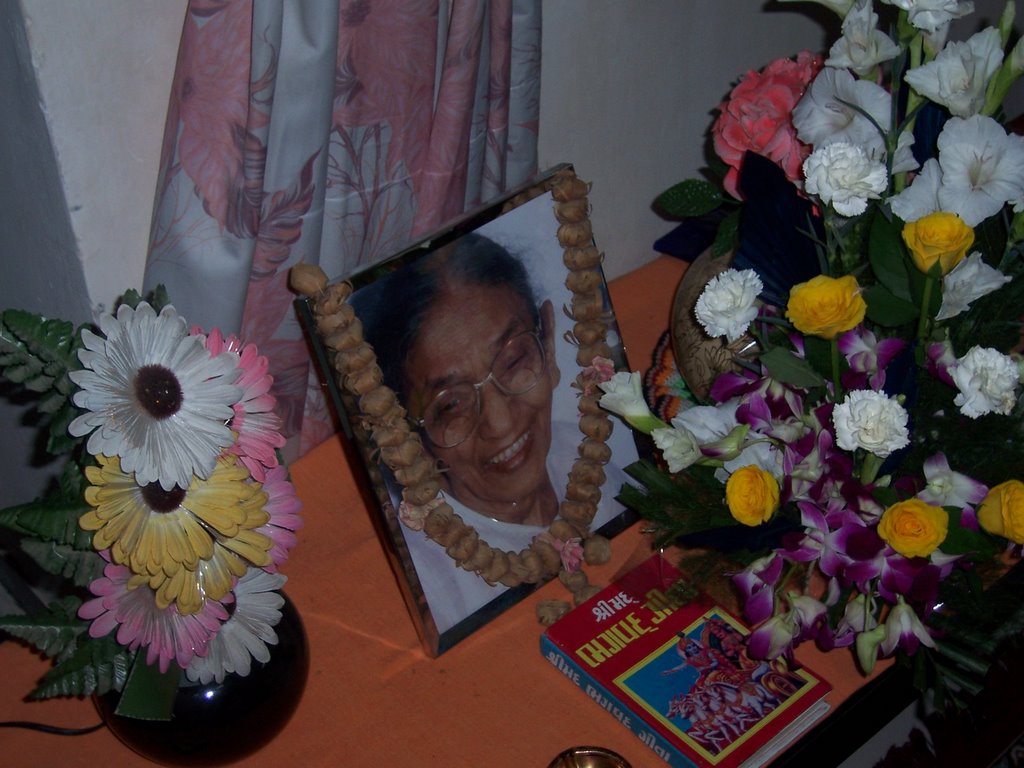
The one person who obviously wasn't with us was my Motiba...my grandmother. The modest shrine to her is the center of most everything. But, it's still not her. Bhai, Masi, Masa, Aalap, and I went to Chandod, near the Sangam of the holy Narmada River, to immerse her aasti, or remains, into eternal peace. The occasion was solemn, and I had the great honor of being the one to remove the aasti from its burial place outside the house and then carry it to the car. I am very thankful for that opportunity. It may have simply been a mundane and perfunctory task, but it meant so much to me.
While I didn't understand the ceremony which occurred before the immersion, I still felt the emotional weight of it, as did we all. The immersion, though quick, seemed like the final punch of goodbye, calling up many emotions to the surface. And all I could think of was my mom. I missed her so much. So much.
This was the reason I came to Ahmedabad when I did. And I'm so glad I did.
Goodbye Motiba. We love you. We miss you. You'll always be with us.
Ahmedabad: It's All Relative 2 -- The Adults
Unfortunately, I didn't have as much time with the adults as with the others, as can be seen from the poor pictures below, many taken from videos or cropped from other photos. Still, they are my relatives, somehow or another, and therefore deserve a mention.

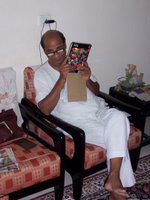
Of course, the most important are Didi Masi and Kamlesh Masa, the parents of Hardik and Prayag Bhai. Didi Masi and Kamlesh Masa have been nothing but welcoming to me. I appreciate the fact that Didi Masi drinks more water than anyone I know, even my mom. Also, that Kamlesh Masa thanks the sun every morning through prayer. The food has been delicious, though I apologize to Kamlesh Masa for my tastes, which have prompted Didi Masi to make food too spicy for his stomach. Still, I see a lot of my mom in Didi Masi, and Kamlesh Masa is the perfect match.


Dhiren Bhai is technically my mom's cousin's son. I've known him and his wonderful wife, Kirti Bhabhi, for many years now. I remember poorly learning how to ride a two-wheeler from him, and competing with eating spicy tomato soup with him. And of course, I remember a baby Aalap and the time in Ramkrupa, with Sejal's three kids, fataafat, lagbag, and thhraas. I hope I'll get to see these two folks before I must leave.


Meena Ben, who is the sister to Chetan Bhai in Bangalore, lives in Jamnagar and was unhappy that my mom left her off the "list" of people for me to know. She is Maitri's mom. I really didn't have much chance to know her. All I know is that she is a teacher, like Meera Ben, whose husband is Bakul Bhai. Meera Ben teaches Montessori style in an amazing school known as Shreyas. I didn't get to know any of them well, but at least I now know that they're family.
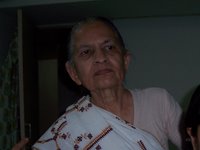
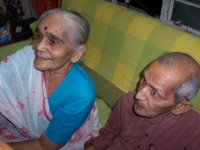
Ah, Manju Masi. I saw her in Bangalore at Raju Bhai's place, but I never had a chance to chat with her. She's a super-cool lady. We have an inside joke about gaining weight due to food, and I scared her by eating a very hot pepper. Bhabhiba and Motamama, Dhiren Bhai and Meera Bhen's parents, thus the grandparents of Aalap, Vatsal, and Suhani (and her brother Sapan, yes Sapan), have been known to me for as long as I can remember. I love them immensely. Both are incredibly caring, and Bhabhiba is my Mom's second mother. Bhabhiba doesn't seem to age, but Motamama's condition worries me.


Uma Masi and Gyansham Masa, shown with Didi Masi and Kamlesh Masa, are also quite nice. Uma Masi is Ashok Mama's sister. They live across the street from Didi Masi. I really didn't get to know them so well, but it was nice to meet them.
Of course, with all these relatives, there are those who aren't really related, but who are still a part of the family. Kishore "Mama" is the brother of Natu Mama's best friend, Batuk "Mama." Kishore Mama's wife, Manda "Mami" is a great cook. His brother, Bahu "Mama" knows a lot, like an encyclopedia. His sister, Baby "Masi" is also very nice. In addition, I met Ami's family and had an amazing lunch with them. Usha Auntie and Narendra (?) Uncle are very nice. Reepal, Ami's sister, works in a bank and reminds me a little of her sister. Shial (?), their brother, is a cool kid who also has some of the rubber wristbands that are so popular.
So, these are the adults. Lots of them, all enriching my time in Ahmedabad. Thanks to them all, and particularly to Didi Masi and Kamlesh Masa.
Of course, one was missing...
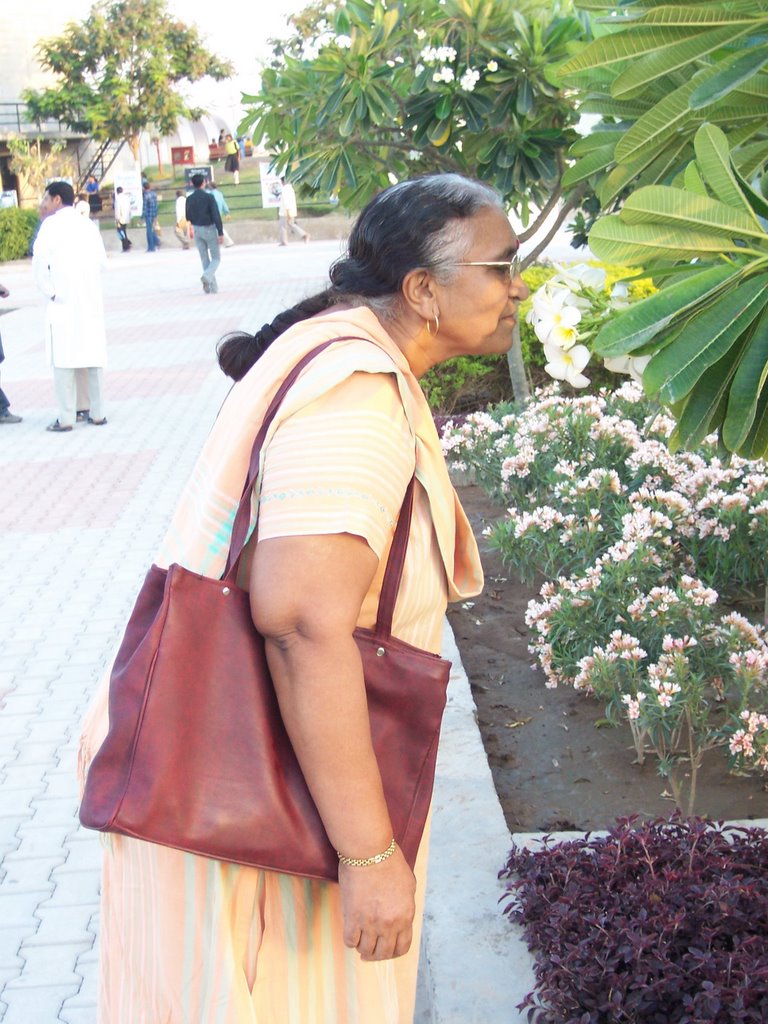

Of course, the most important are Didi Masi and Kamlesh Masa, the parents of Hardik and Prayag Bhai. Didi Masi and Kamlesh Masa have been nothing but welcoming to me. I appreciate the fact that Didi Masi drinks more water than anyone I know, even my mom. Also, that Kamlesh Masa thanks the sun every morning through prayer. The food has been delicious, though I apologize to Kamlesh Masa for my tastes, which have prompted Didi Masi to make food too spicy for his stomach. Still, I see a lot of my mom in Didi Masi, and Kamlesh Masa is the perfect match.


Dhiren Bhai is technically my mom's cousin's son. I've known him and his wonderful wife, Kirti Bhabhi, for many years now. I remember poorly learning how to ride a two-wheeler from him, and competing with eating spicy tomato soup with him. And of course, I remember a baby Aalap and the time in Ramkrupa, with Sejal's three kids, fataafat, lagbag, and thhraas. I hope I'll get to see these two folks before I must leave.


Meena Ben, who is the sister to Chetan Bhai in Bangalore, lives in Jamnagar and was unhappy that my mom left her off the "list" of people for me to know. She is Maitri's mom. I really didn't have much chance to know her. All I know is that she is a teacher, like Meera Ben, whose husband is Bakul Bhai. Meera Ben teaches Montessori style in an amazing school known as Shreyas. I didn't get to know any of them well, but at least I now know that they're family.


Ah, Manju Masi. I saw her in Bangalore at Raju Bhai's place, but I never had a chance to chat with her. She's a super-cool lady. We have an inside joke about gaining weight due to food, and I scared her by eating a very hot pepper. Bhabhiba and Motamama, Dhiren Bhai and Meera Bhen's parents, thus the grandparents of Aalap, Vatsal, and Suhani (and her brother Sapan, yes Sapan), have been known to me for as long as I can remember. I love them immensely. Both are incredibly caring, and Bhabhiba is my Mom's second mother. Bhabhiba doesn't seem to age, but Motamama's condition worries me.
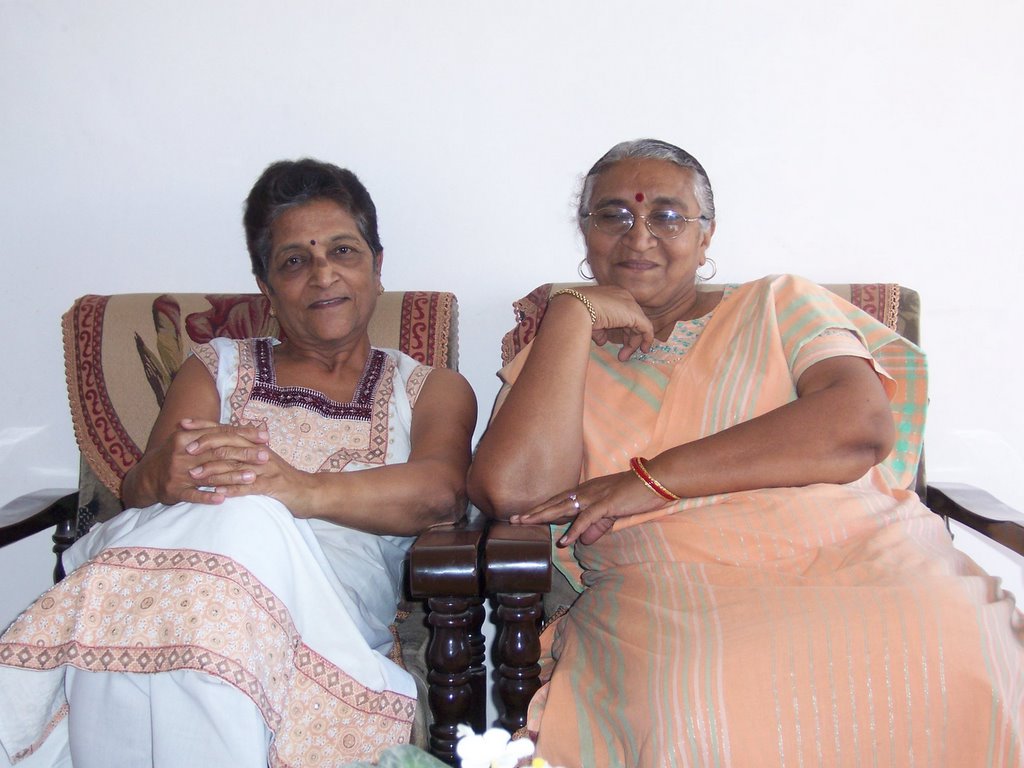
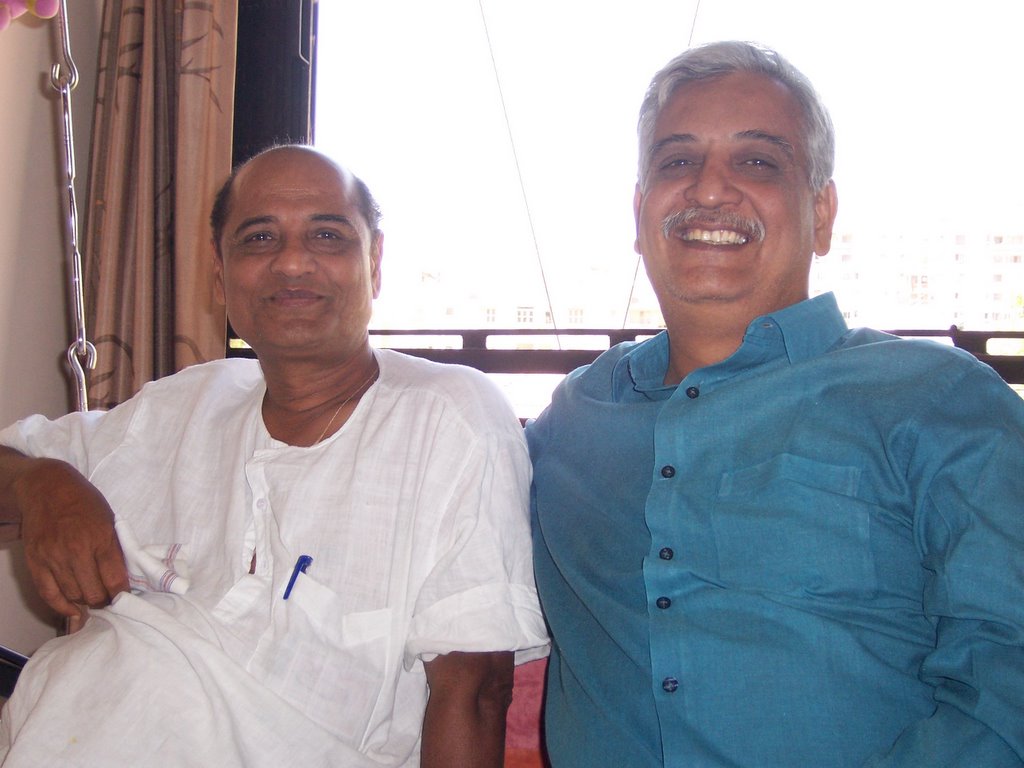
Uma Masi and Gyansham Masa, shown with Didi Masi and Kamlesh Masa, are also quite nice. Uma Masi is Ashok Mama's sister. They live across the street from Didi Masi. I really didn't get to know them so well, but it was nice to meet them.
Of course, with all these relatives, there are those who aren't really related, but who are still a part of the family. Kishore "Mama" is the brother of Natu Mama's best friend, Batuk "Mama." Kishore Mama's wife, Manda "Mami" is a great cook. His brother, Bahu "Mama" knows a lot, like an encyclopedia. His sister, Baby "Masi" is also very nice. In addition, I met Ami's family and had an amazing lunch with them. Usha Auntie and Narendra (?) Uncle are very nice. Reepal, Ami's sister, works in a bank and reminds me a little of her sister. Shial (?), their brother, is a cool kid who also has some of the rubber wristbands that are so popular.
So, these are the adults. Lots of them, all enriching my time in Ahmedabad. Thanks to them all, and particularly to Didi Masi and Kamlesh Masa.
Of course, one was missing...
Ahmedabad: It's All Relative 1--The Young'uns
Something I've come to realize is that there were two reasons to be visit Ahmedabad. First, and most importantly, was to help give Motiba's remains (aasti) to the holy Narmada River. Second was to meet people. Some I met for the first time after seven years. Others I met for the first time period. Sadly to say, I didn't even know that lots of these people even existed. Not that it would have mattered, simply because the kids would have been too young seven years ago anyway. It's funny how when you're younger, age differences seem so large, but when you get older, the same difference means nothing.
I wanted to include all my relatives in this post, but Blogger wouldn't allow me to upload so many pictures. So, this particular post is focusing solely on the people I wouldn't consider "the adults." These people provided much needed excursions and showed me a good time in Ahmedabad. I could "let my hair down" with them, and I would definitely consider them all my friends. So, here they are...


Prayag Bhai...my actual first cousin. His mom, Kalindi Masi (better known as Didi Masi) is my mom's older sister. Kamlesh Masa is his dad. His brother, Hardik, lives in Bangalore with his wife, Ami. For the past seven or eight years, Prayag Bhai has worked with the Art of Living. He is quite spiritual, but with an extremely goofy side as well. Sometimes you never know which side will come out, though both are always welcome. Like everyone in my family, he is very loving but also very teasing with his parents. My kind of guy. He is also my only cousin with a moustache...that's gotta go!

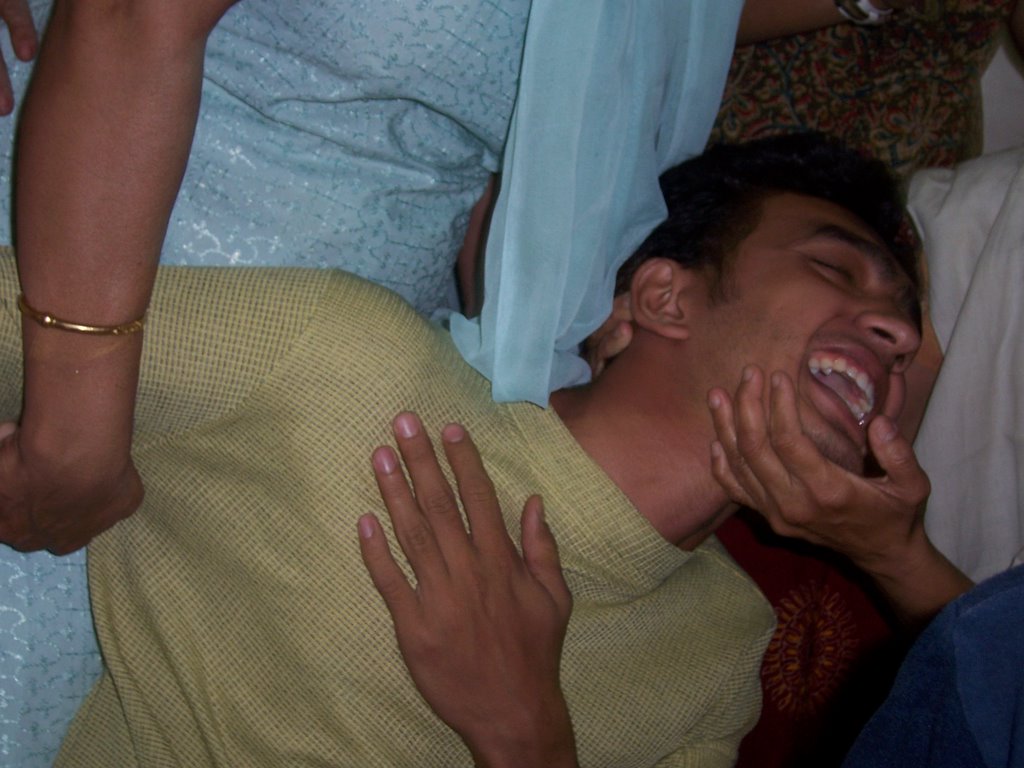

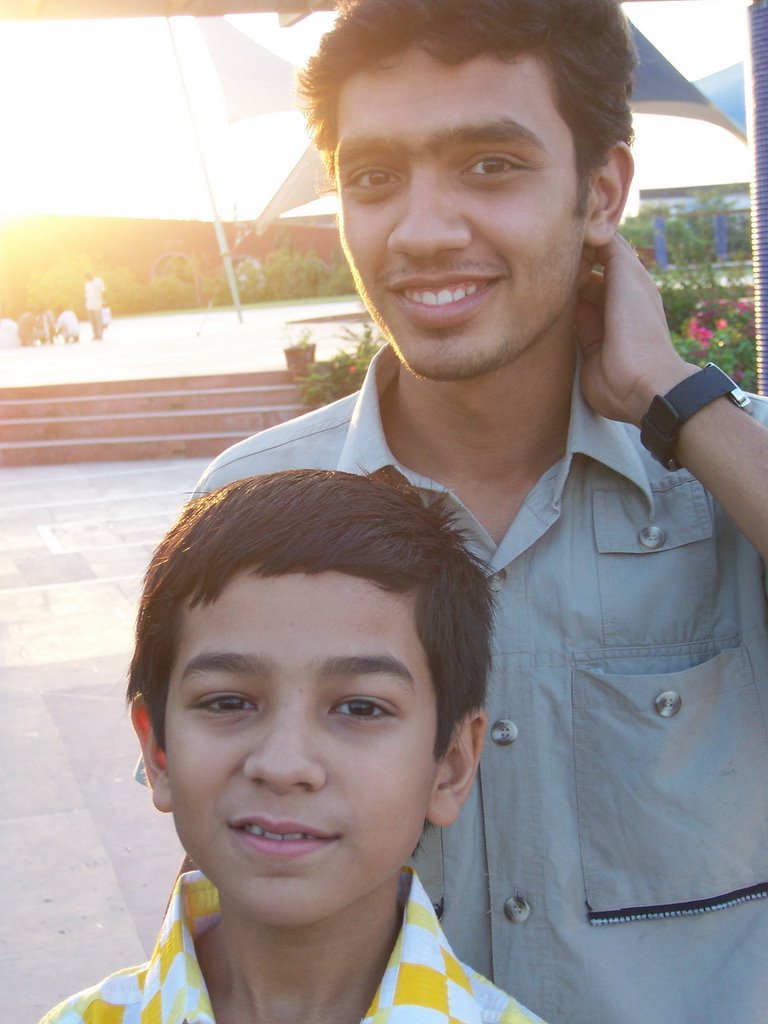
Aalap and Vatsal are technically my...well...I don't really know. Dhiren Bhai, their father, is the son of my mom's cousin, Motamama. So, I suppose I'm their Uncle in some fashion. But they better not start calling me Sapan Kaka! The last time I saw Aalap, he was 11, which now makes him 18. Vatsal, now 12, never knew me. Of course, neither did Aalap really, though I remember him from when he was a baby. Both are very cool, and due to the trip to Chandod, I got to know Aalap better than mostly anyone. I still need to hear him play the violin. Also, Aalap is very good, natural even, at explaining physics concepts. Oh, and Vatsal looks very smart, perhaps even dapper, in his school uniform.


Ah, the women, neither of whom I knew existed before this trip. I unfortunately didn't get to know either so well on this trip. They all attend the same school, though they go to different campuses. Maitri, who is holding that pillow like she needs it to survive, is doing Commerce. She is exceptionally mature for her age, and has a softspoken coolness about her. Suhani, who looks a bit like an old-time movie actress while preparing to get on her two-wheeler, is focusing on biology-maths-chemistry, and is in her final year of university. She has a lively spunk that goes against the stereotypical image of the traditional woman. And while I am also their uncle, they better not dare to call me Sapan Mama!
These five really made my trip to Ahmedabad. The other places I will be visiting, Surat and Bhavnagar, will probably be fun, but not in the same way, for they do not have any youngsters for me to connect with. So, I thank Prayag Bhai (who really isn't a youngster), Aalap, Vatsal, Maitri, and Suhani for putting up with me and my annoying American habits and pronunciation, and I wish them the best in everything they do.
Monday, February 27, 2006
The Same Country?
Even before I got off the train, I started noticing differences between South Indians (SIs) and Gujaratis. I'm sure the list will grow as I spend more time here, but here's a preliminary list:
1. Skin color. SIs are known for their darker skin for a reason. Because it is in fact darker!
2. Facial features. SIs have much harsher features, with thinner faces and highly pronounced cheekbones. Men also tend to wear the same, bushy moustache. Gujaratis have more rounded faces, and it isn't necessary to have the moustache (thankfully!).
3. Vada. Yes, vada, or vadai. In the South, they are big and look like donuts. In Hyderabad, people tried to sell these on the train. Once we entered Gujarat, the vada became small and round, like donut holes.
4. Language. Gujus don't really speak all that much English, and it's barely written anywhere. However, on the plus side, I can read about half of all Gujarati, and I can understand some.
5. Temple Priorities. I just happened to arrive into Gujarat on Shivratri, one of the holiest days for Shaivites. I noticed one key difference in priorities in both my temple experiences. In the South, it's ALL about getting a kum kum (or tikka), you know, the mark on your forehead. People rush all around for a chance at the red, yellow, or ash that soon marks their forehead, neck, and hair part. Here, it's all about the prasad, the food blessed by the god. In the South, you'd typically have to pay for the prasad; here, it's free. Neither of the temples I've visited have even had kanku or kum kum available. Amazing.
1. Skin color. SIs are known for their darker skin for a reason. Because it is in fact darker!
2. Facial features. SIs have much harsher features, with thinner faces and highly pronounced cheekbones. Men also tend to wear the same, bushy moustache. Gujaratis have more rounded faces, and it isn't necessary to have the moustache (thankfully!).
3. Vada. Yes, vada, or vadai. In the South, they are big and look like donuts. In Hyderabad, people tried to sell these on the train. Once we entered Gujarat, the vada became small and round, like donut holes.
4. Language. Gujus don't really speak all that much English, and it's barely written anywhere. However, on the plus side, I can read about half of all Gujarati, and I can understand some.
5. Temple Priorities. I just happened to arrive into Gujarat on Shivratri, one of the holiest days for Shaivites. I noticed one key difference in priorities in both my temple experiences. In the South, it's ALL about getting a kum kum (or tikka), you know, the mark on your forehead. People rush all around for a chance at the red, yellow, or ash that soon marks their forehead, neck, and hair part. Here, it's all about the prasad, the food blessed by the god. In the South, you'd typically have to pay for the prasad; here, it's free. Neither of the temples I've visited have even had kanku or kum kum available. Amazing.
That's It...
The moment I left Secunderabad for Ahmedabad, I said farewell to the South and thus to the traveling portion of this trip. This last leg is strictly for family and volunteering. When I return home (scheduled for the middle of April, for Beezer and P-Dawg's wedding), I'll put together a quick and easy photo tour of the South. For now, you'll just have to settle for a recap of my journey (which won't include Mumbai or Ahmedabad, since they aren't technically in the South):
Bijapur, Karnataka: Gol Gumbaz, Adil Shahi Sultanate
Badami, Karnataka: Forts and Cave Temples, Chalukya Empire
Pattada Kalla, Karnataka: Early experimentation in South Indian temple architecture, Chalukya
Hampi, Karnataka: Ruined capital and tourist hangout, Vijayanagar Empire
Bangalore, Karnataka: Family and a bit of IT
Mysore, Karnataka: Palace and market, Wadiyar (or Wodeyar) Kingdom
Somnathpur, Karnataka: Keshava Temple, Hoysala Empire
Chennai, Tamil Nadu: Vishal and Nisha's Wedding
Pondicherry, Tamil Nadu: Sri Aurobindo Ashram and Auroville
Mamallapuram, Tamil Nadu: Pallava Temples, Dance Festival, and New Year
Thiruvannamalai, Tamil Nadu: Arunachaleswara Temple, Sri Ramakrishna Maharishi Ashram
Thiruchchirappalli (Trichy), Tamil Nadu: Sri Ramanathaswamy Temple
Thanjavur, Tamil Nadu: Sri Brihadiswara Temple and Nayak Palace
Madurai, Tamil Nadu: Sri Meenakshi Temple
Kodaikanal, Tamil Nadu: Hill Station and Pongal Celebrations
Kanniyakumari, Tamil Nadu: Land's End and Swami Vivekananda Mandapam
Trivandrum, Kerala: Ummm...Strikes, Pointless Sights, and Parvathy...the Manipulator
Varkala, Kerala: Beach, tourist hangout, and Kathakali
The Backwaters (Alleppey), Kerala: Canoeing and Houseboating
Kochi (Fort Cochin), Kerala: Jew Town and Chinese Fishing Nets
Munnar, Kerala: Tea Plantation, Leonardo Dicaprio's Movie Set, and Eravikulam NP
The Wayanad (Kalpetta), Kerala: Pookote Lake and Edakkal Caves
Mysore, Karnataka: Chamundi Hill and St. Philomena's Cathedral
Brindavan, Karnataka: Krishnaraja Sagar and the Gardens
Shravanabelagola, Karnataka: Bahubali and Mahamastakabhisheka
Melkote, Karnataka: Hoysala Chaluvanarayana Temple and Yoganarasimha Temple
Srirangapatna, Karnataka: Dariya Daulat Bagh and Gumbaz, Tipu Sultan's Mysore Empire
Halebeedu, Karnataka: Hoysaleswara Temple, Hoysala Empire
Belur, Karnataka: Channakeshava Temple, Hoysala Empire
Hyderabad, Andhra Pradesh: Charminar and Golkonda Fort, Qutb Shahi Sultanate
There you have it. I saw lots. And now it's time for a break...
Bijapur, Karnataka: Gol Gumbaz, Adil Shahi Sultanate
Badami, Karnataka: Forts and Cave Temples, Chalukya Empire
Pattada Kalla, Karnataka: Early experimentation in South Indian temple architecture, Chalukya
Hampi, Karnataka: Ruined capital and tourist hangout, Vijayanagar Empire
Bangalore, Karnataka: Family and a bit of IT
Mysore, Karnataka: Palace and market, Wadiyar (or Wodeyar) Kingdom
Somnathpur, Karnataka: Keshava Temple, Hoysala Empire
Chennai, Tamil Nadu: Vishal and Nisha's Wedding
Pondicherry, Tamil Nadu: Sri Aurobindo Ashram and Auroville
Mamallapuram, Tamil Nadu: Pallava Temples, Dance Festival, and New Year
Thiruvannamalai, Tamil Nadu: Arunachaleswara Temple, Sri Ramakrishna Maharishi Ashram
Thiruchchirappalli (Trichy), Tamil Nadu: Sri Ramanathaswamy Temple
Thanjavur, Tamil Nadu: Sri Brihadiswara Temple and Nayak Palace
Madurai, Tamil Nadu: Sri Meenakshi Temple
Kodaikanal, Tamil Nadu: Hill Station and Pongal Celebrations
Kanniyakumari, Tamil Nadu: Land's End and Swami Vivekananda Mandapam
Trivandrum, Kerala: Ummm...Strikes, Pointless Sights, and Parvathy...the Manipulator
Varkala, Kerala: Beach, tourist hangout, and Kathakali
The Backwaters (Alleppey), Kerala: Canoeing and Houseboating
Kochi (Fort Cochin), Kerala: Jew Town and Chinese Fishing Nets
Munnar, Kerala: Tea Plantation, Leonardo Dicaprio's Movie Set, and Eravikulam NP
The Wayanad (Kalpetta), Kerala: Pookote Lake and Edakkal Caves
Mysore, Karnataka: Chamundi Hill and St. Philomena's Cathedral
Brindavan, Karnataka: Krishnaraja Sagar and the Gardens
Shravanabelagola, Karnataka: Bahubali and Mahamastakabhisheka
Melkote, Karnataka: Hoysala Chaluvanarayana Temple and Yoganarasimha Temple
Srirangapatna, Karnataka: Dariya Daulat Bagh and Gumbaz, Tipu Sultan's Mysore Empire
Halebeedu, Karnataka: Hoysaleswara Temple, Hoysala Empire
Belur, Karnataka: Channakeshava Temple, Hoysala Empire
Hyderabad, Andhra Pradesh: Charminar and Golkonda Fort, Qutb Shahi Sultanate
There you have it. I saw lots. And now it's time for a break...
Ifran: All Hormones, All The Time

There are three Indian youths thus far I will always remember: 1) Karan, from Hampi, who saw through my I'm-Indian-but-I-don't-speak-Hindi ruse and tried to convince me to go with him to the movies; 2) Parvathy, from Trivandrum, who whined and pouted to manipulate me to do things and buy stuff for her; and 3) Ifran, from Hyderabad, for, well, being a kid only interested in sex.
I first met him at a magazine stand with my friend Frank. I didn't think much of him then, but when I passed by the stand the next day, I found out more than I wanted to know. He wanted to know where my friend was...Frank had left for Secunderabad and wasn't coming back. Okay, well, "then do you want a dirty magazine?" Of course, he wanted to sell me porn, which to him was similar to a Maxim or a Cosmo. When he realized that I was American, all on his mind was the women and the openness of sex. He was convinced that Americans were doing it anywhere, everywhere, and at any moment. He asked many truly invasive questions, and seemed fascinated (perhaps a little too fascinated...) at my answers. He even found the fact that men and women sleep in the same bed without being married to be something amazing. But, of course, that wasn't even the start of what he wanted to know. He asked about every dirty thing possible. Hell, if I could blush, I would have. Oh, and Ifran was a 17 year old Muslim boy. And sex was the only thing on his mind.
The next day, I ran into him again, and this time, he had a different goal. He didn't want to sell me porn. No, he actually wanted to experience it. He told me to wait for ten minutes, then we'd go trolling for a woman. This kid had so much confidence that we'd find a luscious woman to, get this, both "have." The kid went from porn-seller to pimp. I, of course, passed on his odd offer. And I still couldn't believe he was 17...and apparently a fairly devout Muslim (though not enough to dress like one...hence the picture above). Still, knowing him gave me a good deal of amusement.
Karan...leech. Parvathy...manipulator. Ifran...hormonal.
Hyderabad: Islam Islam Everywhere, Even In My...
Hyderabad was a short (meaning long) train ride away from Bangalore, which was a short (meaning not too bad) ride from Hassan. As I was heading to Hyderabad the Sunday after the big (meaning 2.5 million attendees) Art of Living Celebration in Bangalore, those people stuck in my berth either attended the festival or wanted to know more about it. The conversation never changed...my music was the only escape from an Art of Living praise-a-thon that lasted about 20 hours. Sheesh. Still, as we approached Hyderabad and its sister-city, Secunderabad, something amazing caught my eyes that told me we weren't in the deep south anymore. All the railway station signs weren't only written in Telagu and English. They also had Hindi and...gasp...Urdu as well. Heading further north (ie the Hindi) and into Muslim territory (ie the Urdu). This brought a great smile to my face.
I liked my hotel. In the Abids area, and thus between the Charminar and the Birla Mandir, as well as near a mall, the hotel gave me a double room with a TV, Western toilet, and hot shower. And I didn't have to pay over my budget! It was really nice. As soon as I settled in, I was out the door and on my way to the Charminar, the key site in Hyderabad. As I was walking the 2 kilometers to get there in the blazing (meaning heatstroke-inducing) sun, a sudden realization came to me. Charminar...char minar...four towers...really? As I crossed the Musi river, which was more like a sludgy trickle than a river, I pondered my realization. There, on the bridge, I saw two of the most amazing buildings ever: the High Court and the Osmania General Hospital, both build in the Indo-Saracenic style also used for the Gaddige tombs in Madikeri. I was awestruck, not only by the architecture, but by the fact that I had literally walked into a Muslim-heavy area. Men were dressed in white kurtas with scullcaps, and women were wearing black burqahs (hijabs) that only revealed their eyes. I wondered how the women didn't die from getting so hot in that sun with the black all over them. This scene was in vast contrast to the Abids area, in which women tended to walk around in jeans and t-shirts. And men, no matter where they were, could easily wear brightly colored shirts. In fact, nothing was weirder than seeing a woman in full burqah walking next to a guy in a bright, sleaveless shirt with shorts. Such gender differences.
I liked my hotel. In the Abids area, and thus between the Charminar and the Birla Mandir, as well as near a mall, the hotel gave me a double room with a TV, Western toilet, and hot shower. And I didn't have to pay over my budget! It was really nice. As soon as I settled in, I was out the door and on my way to the Charminar, the key site in Hyderabad. As I was walking the 2 kilometers to get there in the blazing (meaning heatstroke-inducing) sun, a sudden realization came to me. Charminar...char minar...four towers...really? As I crossed the Musi river, which was more like a sludgy trickle than a river, I pondered my realization. There, on the bridge, I saw two of the most amazing buildings ever: the High Court and the Osmania General Hospital, both build in the Indo-Saracenic style also used for the Gaddige tombs in Madikeri. I was awestruck, not only by the architecture, but by the fact that I had literally walked into a Muslim-heavy area. Men were dressed in white kurtas with scullcaps, and women were wearing black burqahs (hijabs) that only revealed their eyes. I wondered how the women didn't die from getting so hot in that sun with the black all over them. This scene was in vast contrast to the Abids area, in which women tended to walk around in jeans and t-shirts. And men, no matter where they were, could easily wear brightly colored shirts. In fact, nothing was weirder than seeing a woman in full burqah walking next to a guy in a bright, sleaveless shirt with shorts. Such gender differences.


Subscribe to:
Posts (Atom)